Knowledge Base
Home Battery as Emergency Backup: The Complete Guide for Power Outages
Everything about emergency backup power with a home battery: which batteries offer backup function, what does it cost, and how do you protect your home during a blackout? Compare EPS vs full backup, costs and installation requirements.
Patrick25 March 202615 min read
Back to blog
Start quiz
What is emergency backup power with a home battery?
Emergency backup power with a home battery ensures your home keeps receiving electricity when the power grid fails. Instead of sitting in the dark, your backup battery automatically switches over and powers your essential appliances: lighting, fridge, wifi router, alarm system and potentially medical equipment. For an increasing number of households across Europe, a home battery with backup function is no longer a luxury but a conscious investment in security.
Our daily lives depend entirely on electricity. Heat pumps replace gas boilers, we cook on induction, work from home, charge cars and depend on wifi for everything — from banking to alarm systems. A power outage in 2026 means: no heating, no hot water, no internet, no cooking, no communication. The European power grid is reliable (on average 23 minutes of outage per year in the Netherlands), but that is an average. During winter storms or grid congestion, an outage can last hours. In February 2025, thousands of households in Limburg were without power for over 6 hours.
Important: not every home battery provides backup power
Most inverters automatically shut off during a grid failure (anti-islanding protection). This is legally required to prevent power from being fed back into the grid while engineers work on a fault. Your battery can be full with 10 kWh of energy but delivers 0 Watts during an outage — unless your system has specific backup power hardware. Always check this before purchasing.
Home battery as emergency backup: how does it work?
A home battery as emergency backup works with an isolated circuit separate from the electricity grid. As soon as the grid fails, the inverter detects this within milliseconds. In systems with backup function, the system automatically switches to battery power via a dedicated emergency power socket or via a transfer switch in the electrical panel. The grid is physically disconnected (island mode), after which the battery takes over the power supply.
How long you can keep running depends on two factors: the storage capacity of your backup battery (in kWh) and the consumption of the connected appliances. A typical emergency scenario — fridge, wifi, lighting and phone charger — uses about 200-300 Watts. With a 10 kWh battery at 80% capacity, you can run for 25-40 hours. Combine this with solar panels and during a prolonged outage you can charge during the day and run through the night — potentially for days on end.
Backup battery for power outages: EPS vs full backup
There are two fundamentally different ways a backup battery for power outages works. The choice between them determines your budget, installation complexity and comfort during a power cut.
Emergency Power Socket (EPS — Emergency Power Supply)
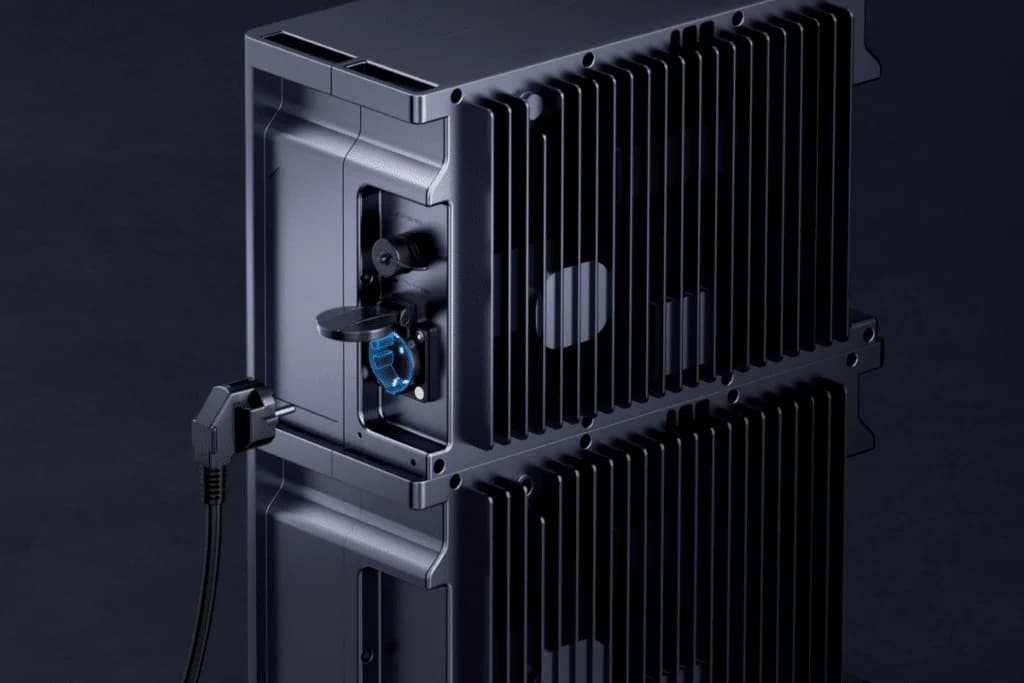
The simplest emergency power solution is a dedicated emergency power socket on the battery or inverter. During a power outage, the system automatically switches to an isolated emergency circuit. You connect essential appliances via an extension lead or power strip. The power is usually limited to 1-3 kW.
- No installation needed — the emergency power socket is on the device; no changes to your electrical panel required
- Low cost — included with many systems or maximum €300 extra
- Limited power — 800W to 3 kW, sufficient for fridge, wifi, lighting and phone charging
- Manual connection — you must physically connect appliances to the emergency power socket
Full panel backup (whole home emergency power)
With a full backup power system, the battery is integrated into your electrical panel via a transfer switch. During a power outage, the battery automatically takes over the power supply for your entire home — or selected circuits. You barely notice the grid has gone down.
- Automatic switchover — all connected circuits are seamlessly powered, no manual connecting
- High power — 5-15 kW, enough for heat pump, induction hob and entire home
- Professional installation required — a certified electrician must install and inspect the transfer switch
- Higher investment — expect €1,500-2,500 extra for components and installation
Comparison: emergency power socket vs panel backup
| Feature | Emergency Power Socket (EPS) | Panel Integration |
|---|---|---|
| Installation | DIY (plug-and-play) | Certified electrician required |
| Backup power | 800W – 3,000W | 3,000W – 15,000W+ |
| Switchover | Automatic (connected appliances only) | Automatic (entire home or circuit) |
| Additional cost | €0 – €300 | €1,500 – €2,500 |
| Suitable for | Basic backup, renters, low consumption | Full home, home office, medical equipment |
| Heat pump / induction | No (insufficient power) | Yes (with sufficient power and capacity) |
Difference: EPS (Emergency Power Supply) vs UPS
A common question is the difference between EPS (Emergency Power Supply) and UPS (Uninterruptible Power Supply). The crucial difference is in the switchover speed. An EPS system has a brief interruption of 0.5 to 10 seconds during switchover. During that interruption, clocks reset, computers restart and your wifi briefly drops out.
A UPS function provides a virtually instant switchover — within 20 milliseconds, imperceptible to all equipment. This is essential if you have sensitive devices: a NAS, home server, medical equipment or security systems that absolutely must not go down. For most households, standard EPS backup power is sufficient — your fridge and heating continue running after a few seconds.
| Feature | UPS Function | Standard EPS Backup |
|---|---|---|
| Switchover speed | < 20 ms (imperceptible) | 0.5 – 10 seconds |
| Computers/NAS safe | Yes, no restart needed | No, may restart |
| Medical equipment | Yes (with proper certification) | No, not reliable enough |
| Additional cost | €200 – €500 on top of backup power | Included with backup power option |
Which home batteries have backup function?
Not all home batteries with backup function are equal. Below we discuss the most popular models with their emergency power capabilities, so you can choose the right backup battery.
Anker SOLIX X1 — Best complete backup power solution
The Anker SOLIX X1 offers full panel backup power with automatic switchover. Up to 6 kW continuous power and expandable up to 30 kWh storage. The system is professionally installed and can power your entire home during an outage — including heat pump and induction hob (with sufficient power). The backup function is included as standard.
Anker SOLIX Solarbank 2 — Affordable backup with EPS
The Anker SOLIX Solarbank 2 E1600 Pro has a built-in emergency power socket with 800W power. Ideal as a basic backup battery for wifi router, lighting and phone charging. The plug-and-play system requires no installation, making it the most accessible emergency power solution on the market. From €999.
Which home battery suits you?
Take our free quiz and find out in 2 minutes.
Tesla Powerwall — Premium backup with UPS
The Tesla Powerwall offers full panel backup power with optional UPS function. With 13.5 kWh per unit (stackable to 40.5 kWh) and AI-powered software, this is a premium solution. The switchover is virtually instant. Price range: from €8,000 including installation.
Dyness Tower T10/T15 — Backup via hybrid inverter
The Dyness Tower series offers backup power via a compatible hybrid inverter. Up to 10 kW backup power depending on the chosen inverter. Professional installation and configuration required. Suitable for larger installations where high power and modular design are important.
Pylontech Force H2 — Flexible backup for large systems
The Pylontech Force H2 provides backup power via a hybrid inverter and is particularly popular with installers thanks to its modular design (expandable from 7 to 21 kWh). Backup power depends on the chosen inverter but can reach up to 15 kW. A popular choice for larger homes and small businesses.
| Brand / Model | Backup type | UPS function | Backup power | From price |
|---|---|---|---|---|
| Anker SOLIX X1 | Panel (full) | Optional | Up to 6 kW | From €3,500 |
| Anker SOLIX Solarbank 2 | Socket (EPS) | No | 800W | From €999 |
| Tesla Powerwall | Panel (full) | Yes | Up to 9.6 kW | From €8,000 |
| Dyness Tower T10/T15 | Panel (via inverter) | Depends on inverter | Up to 10 kW | From €3,000 |
| Pylontech Force H2 | Panel (via inverter) | Depends on inverter | Up to 15 kW | From €2,800 |
How much power do you need during a blackout?
How much power you need from your backup battery depends on which appliances you want to keep running during a power outage. Below is an overview of typical consumption for common household appliances:
| Appliance | Typical consumption |
|---|---|
| Wifi router | 15 – 20 Watts |
| LED lighting (5 lamps) | 40 – 50 Watts |
| Fridge/freezer | 100 – 200 Watts |
| Laptop + charger | 50 – 80 Watts |
| Phone charging | 10 – 25 Watts |
| Heat pump | 1,500 – 4,000 Watts |
For basic emergency power — wifi, fridge, lighting and phone charging — you need about 250-350 Watts. An emergency power socket with 800W is more than sufficient. If you also want to run your heat pump and induction hob, you need full panel integration with at least 5 kW power.
Example calculation: how long does your backup power last?
With a 10 kWh battery at 80% and consumption of 300 Watts (fridge + wifi + lighting), you can last over 26 hours. Add a heat pump (2,000W average) and the battery is empty within 3.5 hours. Combine with solar panels for unlimited daytime autonomy.
Costs of an emergency power solution
The cost of a backup power solution varies significantly depending on the type of system. With plug-and-play systems, the emergency power function is often included as standard. With full panel integration, additional costs come from the transfer switch, cabling and professional installation.
| Cost item | EPS (socket) | Panel integration |
|---|---|---|
| Home battery (10 kWh) | From €999 | From €3,000 |
| Backup power function | Included | €0 – €500 surcharge |
| Transfer switch + cabling | Not required | €300 – €500 |
| Electrician installation | Not required (plug-and-play) | €1,000 – €1,500 |
| Total indication | €999 – €1,500 | €4,500 – €6,000 |
Note: prices shown include VAT. When purchasing a home battery together with solar panels or as part of an energy renovation, you may be eligible for VAT benefits or regional subsidies. View our current prices in the webshop.
Installation requirements for backup power
The installation requirements differ significantly between an emergency power socket and full panel integration. Below is an overview of what you need for each option.
Emergency power socket installation (plug-and-play)
- No electrician needed — you place the battery, connect solar panels and plug the system into a wall socket. The emergency power output is immediately available.
- Extension lead or power strip — connect your essential appliances to the emergency power output. Have a suitable extension lead ready.
- Ventilation — place the battery in a dry, ventilated location. Not in a sealed cupboard without air circulation.
Panel backup power installation (professional)
- Certified installer required — the transfer switch must be installed and inspected by a certified electrician according to local regulations.
- Compatible inverter — not every inverter supports backup power. Check this in advance. Popular choices: SolarEdge, Fronius, GoodWe and Huawei.
- Sufficient space in electrical panel — the transfer switch takes up 2-4 circuit breaker positions. Older panels may need replacement.
- Inspection required — after installation, the system must be inspected. Keep the inspection report with your property documentation.
Practical tips for your backup power system
- Keep at least 20% reserve — Set your battery to never discharge below 20%. This way you always have a buffer for emergency power. Most battery apps offer this setting.
- Test your backup power quarterly — Switch off your main breaker briefly to check that the backup power works correctly. This ensures everything functions when you need it.
- Create a priority list — Determine in advance which appliances are essential. Router (20W) + fridge (150W) + lighting (50W) = 220W. With 800W you have more than enough for basic backup.
- Consider a separate UPS for computers — EPS backup power switchover takes a few seconds. Computers, NAS systems and servers may shut down. A small UPS (€50-100) bridges this gap.
- Combine with solar panels — During a longer daytime power outage, your solar panels recharge the battery. This way you can run independently for days.
- Inform your household — Make sure everyone in the house knows where the emergency power socket is and which appliances should be connected during a power outage.
Frequently asked questions about backup power
Does every home battery automatically provide backup during a power outage?
No, this is the most common misconception. Most home batteries automatically shut off during a grid failure due to anti-islanding protection. Only systems with specific backup hardware (EPS output or transfer switch) provide power during an outage. Always check this before purchasing.
How much does a home backup battery cost?
A backup battery with emergency power socket (EPS) starts from €999 (such as the Anker SOLIX Solarbank 2). For full panel backup with professional installation, expect €4,500 to €6,000. The backup function itself often costs little to nothing extra — the additional costs are mainly for the transfer switch and installation.
Can I use a home battery as backup power for my heat pump?
That depends on the type of backup power. An emergency power socket (EPS) provides maximum 800W-3 kW, which is insufficient for most heat pumps (1.5-4 kW). For a heat pump you need full panel integration with at least 5 kW backup power. Systems like the Anker SOLIX X1 and Tesla Powerwall can handle this. Also read our guide on combining a heat pump with a home battery.
How long does backup power last during a blackout?
The duration depends on your battery capacity and consumption. With a 10 kWh battery and basic backup (wifi + fridge + lighting, approx. 250W), you can last 30+ hours. With heavier consumption including a heat pump, the battery is empty in 3-5 hours. With solar panels you can recharge during the day for longer autonomy.
What is the difference between backup power and a generator?
A home battery backup switches over automatically (no manual action), is quiet, emission-free and requires no fuel. A generator is cheaper to buy but requires fuel, is loud (60-80 dB), produces emissions and must be started manually. For homes in residential areas, a home battery with backup power is by far the most practical solution.
Is home battery backup suitable for medical equipment?
Only systems with a true UPS function (switchover < 20 ms) are reliable enough for medical equipment. Standard EPS backup has an interruption of 0.5-10 seconds, which may be too long for e.g. CPAP machines or oxygen concentrators. Always consult the manufacturer of your medical device and discuss with your installer.
Can I add backup power to my existing home battery later?
This depends on your current system. Some batteries (like the Anker SOLIX Solarbank) have the emergency power socket as standard. For panel integration, your inverter must support backup power — not all models do. A certified installer can assess whether your system is suitable for adding backup power.
Conclusion: buying a home battery with backup power
A home battery with backup function is one of the smartest investments for your home in 2026. Whether you choose an affordable emergency power socket (EPS) from €999 or a full panel backup solution — you are protected against power outages. The technology is reliable, prices are dropping fast and installation is simpler than ever.
Want to know which backup power solution best suits your situation? Request free advice or view our home batteries with backup power in the webshop. You can also consult our complete home battery buying guide for a comprehensive comparison.
P
Patrick from Home Energy Solutions
Founder & certified energy advisor
Always power, even during outages
View our home batteries with backup power function or request free personal advice on the best emergency power solution for your home.
Related Articles
Continue reading about home energy
Ready to order?
Browse our complete range of home batteries with the best value for money.